Realism tattoos: portraits, black and grey, colour and what to know
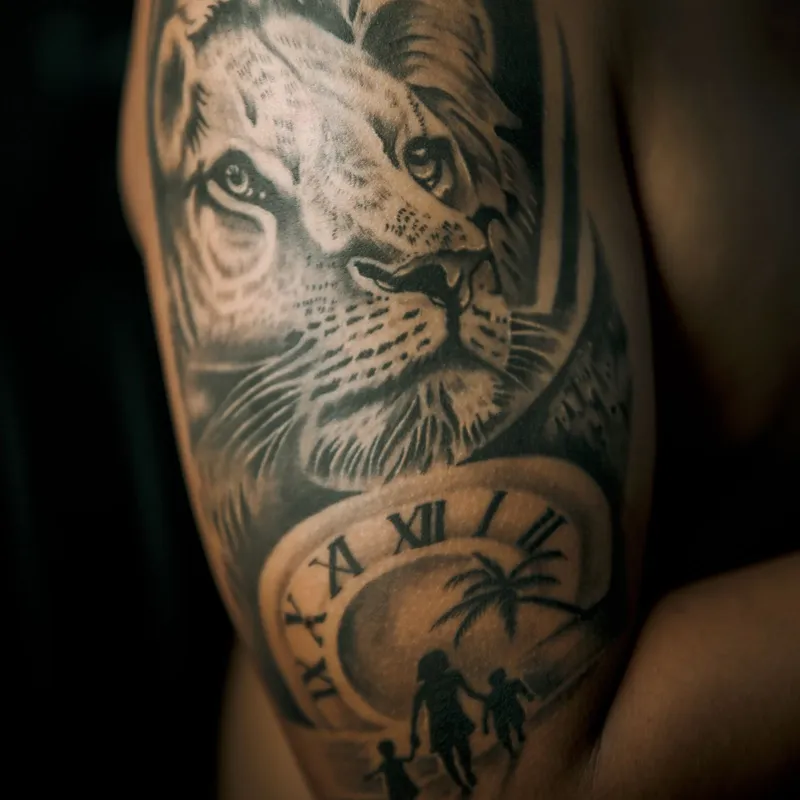
A realism tattoo aims to look like a photograph or a lifelike painting on skin: portraits, animals, nature, objects. It relies on smooth gradients, precise contrast and careful detail rather than outlines. It's one of the most technically demanding styles, and results vary a lot between artists. This guide explains the main types, what makes a good realism piece, and what to prepare before you book.
What defines realism
Where traditional tattoos use bold outlines and flat colour, realism builds images from light and shadow. Typical features:
- Few or no outlines: shapes are defined by contrast
- Smooth gradients from deep black or saturated colour to bare skin
- Accurate proportions, especially in faces and animals
- Texture: skin, fur, feathers, fabric, stone
Within realism, artists usually specialise further.
Black and grey realism
Built with black ink diluted to different shades of grey. It's a classic choice for portraits, statues, religious imagery and atmospheric scenes, and it suits many skin tones.
Colour realism
Uses a full colour palette for lifelike images, often animals, flowers, portraits and pop culture. It demands strong colour theory and contrast.
Micro-realism
Very small, detailed images. Attractive, but small details close together can blur over the years, so discuss size carefully. Our guide to fine line tattoos covers how thin detail ages.
Surrealism and realistic mash-ups
Realistic elements combined in impossible ways. Here the artist's design skills matter as much as technique.
Portraits: the most personal realism
Portraits of loved ones, pets or famous figures are among the most requested realism tattoos. They're also the least forgiving: a small error in the eyes or mouth changes the likeness. Points to consider:
- Choose an artist with healed portraits in their portfolio, not just fresh ones
- Size matters: a face needs room for detail; your artist will advise on the minimum
- One clear subject often works better than several faces in a small space
The reference photo makes or breaks it
For realism, the tattoo can only be as good as the reference. A good reference photo is:
- Sharp and high resolution, not a screenshot or a heavily compressed image
- Well lit, with clear light and shadow on the face or subject
- Not heavily filtered or edited
- Taken from a suitable angle for the placement you have in mind
If you're not sure, send several options and let the artist choose. If the photo isn't yours, make sure you have the right to use it, especially for photos taken by professional photographers.
How realism ages
All tattoos soften over time. Realism relies on subtle gradients and contrast, so the artist has to build in enough contrast from the start: dark darks and bright lights. A piece that looks perfect fresh but has little contrast can look flat after a few years. Sun protection after healing also matters. Ask the artist to show healed realism that is a few years old.
Placement
Realism needs a relatively flat, stable area with enough room: upper arm, forearm, calf, thigh, back or chest. Areas that bend or twist a lot can distort faces. Discuss placement with your artist, especially for portraits, and ask how the area tends to feel during a long session.
Sessions and price
Realism usually takes longer than line-based styles because of the layering. Larger pieces are often done over several sessions with healing time in between. Prices depend on size, detail and the artist; ask for an estimate for your specific piece and how the deposit works for multi-session work.
Choosing a realism artist
Realism specialists are easy to recognise by their portfolio. Look for:
- Several healed pieces in the type of realism you want
- Faces that look right from a distance and up close
- Strong contrast and smooth transitions without patchy areas
- Consistent quality across the portfolio, not one standout piece
Many people travel for a realism specialist. Our tattoo shop directory lists studios by country and city with the styles they work in.
Black and grey or colour: how to choose
Both can be stunning; the choice depends on the subject, your skin and your taste.
- Black and grey suits portraits, statues, religious imagery and moody scenes. It relies on contrast and tends to hold its depth well over time.
- Colour realism brings animals, flowers and vivid scenes to life. It needs strong contrast and saturated colour to stay readable as the tattoo ages.
Look at the reference photo: a colourful photo doesn't automatically mean colour is the best choice for skin. Some images become stronger in black and grey, and some colour subjects lose their impact without colour. Skin tone also plays a role in how colours appear. Ask your artist which approach they recommend for your image and placement, and to show healed examples of both. Many realism artists specialise in one of the two, so the choice of artist often follows the choice of style.
Booking
Send a complete request with your reference photo, placement, size and any elements you want to add. A booking request form with image uploads makes it easy to include high-resolution images. Expect a consultation for larger or portrait work.
Realism and cover-ups
Dark, high-contrast realism can sometimes be used for cover-ups, but it depends on the old tattoo. Ask an artist who does both realism and cover-ups to look at the old piece in person.
For realism artists
Clients compare realism portfolios closely, often zooming in on their phones. Show high-resolution photos, label healed work and group portraits, animals and other subjects clearly. With the OnlineTattoo.art tattoo website builder every artist has a portfolio sorted by style, next to a booking form where clients can upload their reference photos.
Photo: jovan curayag / Pexels