Tattoo shop website checklist: 30 points to check before you go live

A tattoo shop website works when a visitor can answer three questions within a minute: is this the right artist for my style, how do I book, and where are you? This checklist turns that into 30 concrete points, grouped by topic. Use it before you launch a new site, or once a year to check the one you have. Each point is a yes or no; every no is a quick improvement.
How to use this checklist
Open your website on your phone, not on a laptop. Most clients look at tattoo sites on a phone, often while scrolling social media. Go through the points below and tick each one off honestly. If you want the background on which pages a shop site needs, read how to build a tattoo shop website first; this article is the checklist that goes with it.
Home page (points 1–5)
- Within the first screen it's clear this is a tattoo shop, in which city
- The styles you do are named in plain words, such as fine line, blackwork or traditional
- There's one clear button to book or send a request
- Your strongest recent work is visible without scrolling far
- The page loads quickly on mobile data
The home page is not the place for a long story about the shop's history. A few lines and a clear next step work better.
Artists and portfolio (points 6–11)
- Every artist has their own page with name, styles and portfolio
- Portfolios can be filtered or sorted by style
- Healed work is shown and labelled as healed
- Photos are sharp, well lit and without heavy filters
- Old work that no longer shows the current style has been removed
- Each artist page links to that artist's booking form
Clients choose an artist, not a building. If your site shows all work in one big grid, people who want a specific style have to search. Our tips on tattoo portfolio photography help with point 9.
Booking (points 12–17)
- The booking form asks for idea, placement, size, colour or black and grey, and reference images
- Clients can choose an artist, or "no preference"
- Your deposit rules are shown next to the form, before anyone pays
- Your rescheduling and cancellation rules are written out
- Clients know what happens after they send a request, and roughly when they'll hear back
- If books are closed, the page says so and tells people when they reopen
A tattoo booking request form is included in every OnlineTattoo.art site. Online deposits, per-artist calendars and reminders are in development as the Bookings add-on.
Flash and shop (points 18–20)
- Available flash is on its own page, with prices
- It's clear whether a design is one-off or repeatable
- If you sell aftercare, prints or merch, there's a webshop with online payment
Location and contact (points 21–24)
- Your full address is on the site as text, not only in an image
- Opening hours are listed, including how walk-ins work
- Phone number or e-mail is easy to find
- The name, address and phone number match your Google Business Profile exactly
Trust and information (points 25–27)
- Aftercare instructions are on the site for clients to look up
- A short FAQ answers the questions you get every week
- Hygiene and age rules are mentioned, so clients know what to expect
Technical basics (points 28–30)
- The site runs on your own domain with SSL (the padlock in the browser)
- Every page has a clear title and description for search results
- Links from your old website still work, thanks to redirects
Your own domain is free for the first year on OnlineTattoo.art, with SSL and DNS handled, and when you move from another site we set up redirects from your old URLs.
Do the check together
If you work in a studio with several artists, go through the checklist together. Each artist checks their own page: is the portfolio current, are the styles right, does the booking form go to them? Ask one or two regular clients to look at the site on their phone and tell you what was unclear. Fresh eyes notice gaps you no longer see, such as an address that's hard to find or a booking button that disappears on small screens. Write down every "no" with a name and a date next to it, so the fixes actually happen.
Scoring your site
- 27–30 yes: your site is in good shape; focus on keeping portfolios fresh
- 20–26 yes: a few gaps, usually in booking information or local details; fix those first
- Under 20: your site is probably costing you bookings and DM time
The points with the most impact are usually 3, 6, 12, 14 and 21: a clear booking button, a page per artist, a complete booking form, visible deposit rules and an address as text.
Common gaps we see
Most shop sites score well on looks and badly on information. The work looks great, but there's no address as text, no deposit information and one booking e-mail address for the whole team. Those gaps are quick to fix and make a difference for both clients and search engines.
Another common gap is the mobile view. A site that looks fine on a big screen can be hard to use on a phone: tiny text, buttons too close together, a menu that hides the booking link. Check every point on your phone.
Fixing the gaps
You can work through the list yourself, one point at a time. Or start fresh: the OnlineTattoo.art tattoo website builder is built around these points, with a page and portfolio per artist, a booking form, flash pages and a webshop. With a free website preview we build a first version from your Instagram or current site, so you can compare it with what you have now.
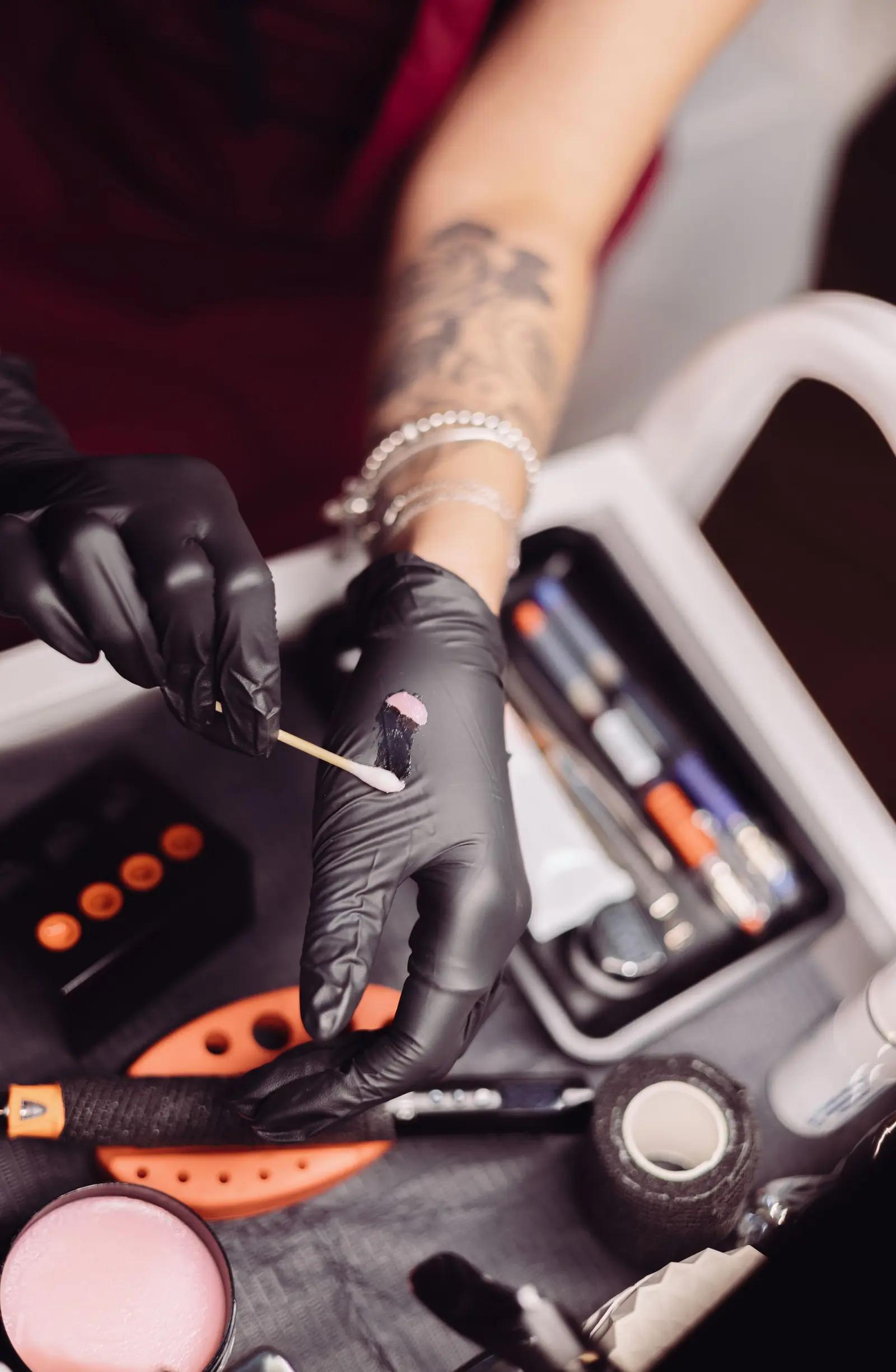
Photo: Pavel Danilyuk / Pexels